Product Guide
Coco Peat Export Guide: Specifications, Packing and Documents
Coco peat is traded on a handful of measurable properties, and most disputes come from a lot that was quoted by name rather than by those numbers. This guide covers what to specify, how it is packed and shipped, and which checks and documents buyers usually ask for. It is orientation for a first order, not a technical standard.
Written by Raju Y.
- 5 min
- Reading time
- 7
- Sections
- 4
- Questions answered
- 15 Sept 2026
- Last reviewed
In this guide
Sourcing this product? See our Coco Peat & Coir Pith product page for specifications, HS code and MOQ.
At a glance
Reading a Coco Peat Spec (Washed Grade)
EC (mS/cm)
Up to about 0.5
pH
5.5 – 6.5
Moisture at packing
Up to about 18%
Start With the End Use
The right grade depends on what the material will do. A greenhouse or nursery grower, a growing-media blender and a buyer using it for soil conditioning need different specifications, and the price follows the processing. If you are unsure whether you need raw coir pith or washed, buffered coco peat, read our comparison of coco peat and coir pith first, then describe the application to us rather than asking for a product name alone.
The Specification Points to Agree
Put these in writing before a quotation is accepted. The ranges below are typical for washed grades and are confirmed against the specific lot, not guaranteed.
| Property | Typical range | Why it matters |
|---|---|---|
| EC (electrical conductivity) | Up to about 0.5 mS/cm for a low-EC washed grade | A measure of salt content; high EC can stress seedlings and salt-sensitive crops |
| pH | About 5.5 to 6.5 | Affects nutrient availability for the crop |
| Moisture at packing | Up to about 18% | Drives weight, shelf behaviour and the expansion you get per block |
| Particle size / mesh | About 2 to 10 mm, fine to coarse | Sets water retention versus aeration; mixes often combine grades |
| Buffering status | Buffered or unbuffered | Buffering swaps bound sodium and potassium for calcium and lowers effective EC |
Ask for the EC value and whether the material has been washed and buffered. If a supplier cannot answer both, the quote is probably for raw pith whatever it is labelled.
Formats: Blocks, Bales, Grow Bags
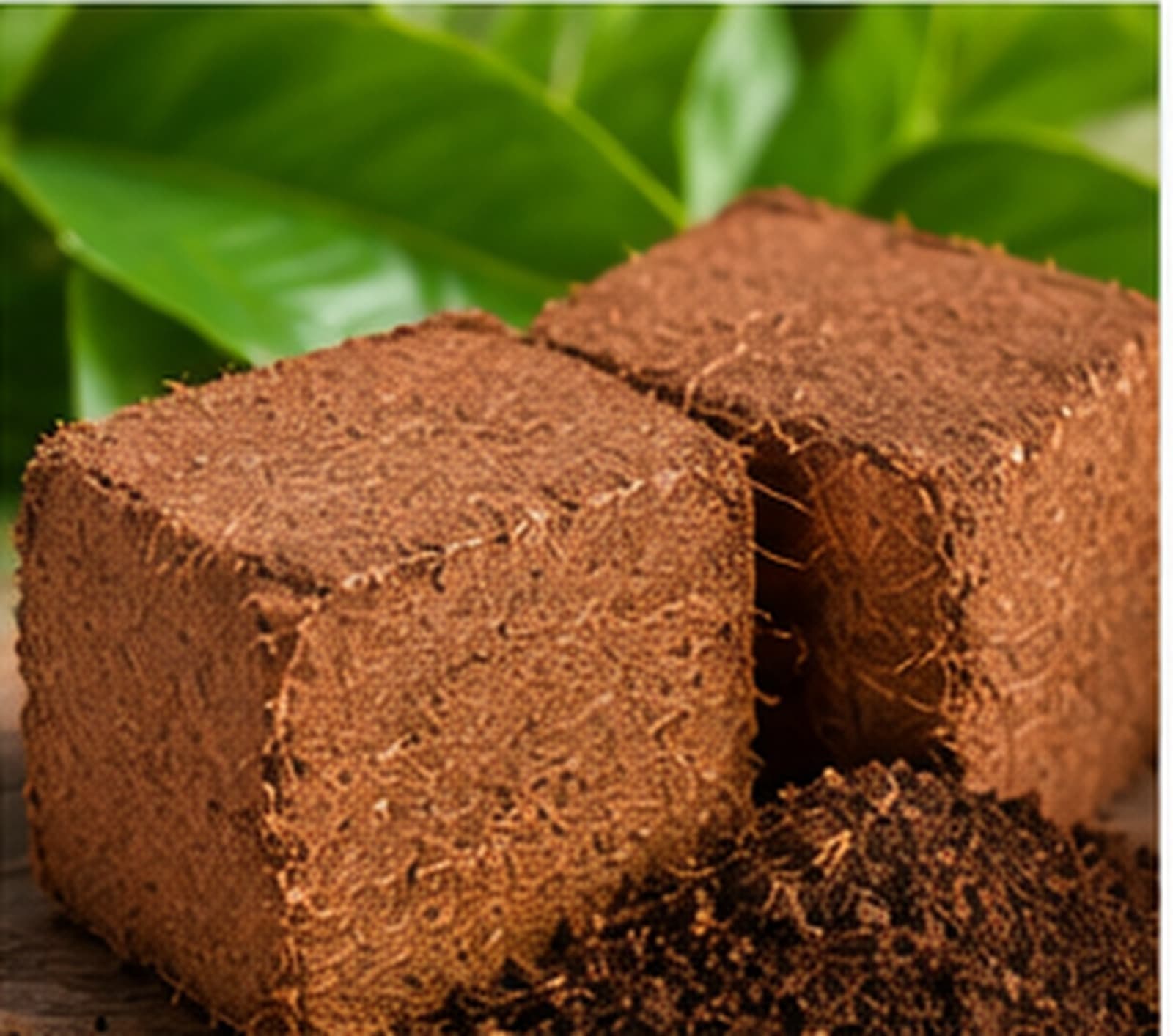
- Compressed blocks expand when rehydrated and are the usual format for shipping distance and container economy
- Bulk bales suit buyers who process or blend material themselves
- Washed and low-EC grades, and grow bags, are specified separately; confirm the format when you ask for a price
- Block weight and expansion volume vary by supplier, so confirm the block size you need and the expansion you expect per block
Loading, MOQ and Lead Time
Coco peat is normally bought by the container because it is bulky for its value. Our indicative MOQ is one container load, confirmed per order and destination. How many blocks fit depends on block size and how tightly the supplier presses and palletises, so ask for a loading plan with the quote rather than assuming a tonnage. Our MOQ and container-load guide explains how the arithmetic works for the products we ship.
Dry storage matters before loading: the material is stable when dry, and wet or damp blocks are a quality and handling problem in transit. Say how you want it packed (shrink-wrapped, palletised or loose) in the first enquiry.
Testing Before Shipment
For a first order, ask for a laboratory report on the lot covering EC, pH and moisture, and agree who tests, which method applies and what happens if the lot misses the agreed range. Samples are offered before bulk where practical, and the lot is checked against the written specification before dispatch. We coordinate this with the supplying unit; we are a merchant exporter and do not run our own laboratory.
Documents and Import Rules
Coco peat is a plant-derived growing medium, so importing countries often treat it as a biosecurity item rather than a food item. Which documents apply depends on the destination, and the biosecurity side is where requirements are least uniform.
- Commercial invoice, packing list and Certificate of Origin, coordinated as one consistent set
- A phytosanitary certificate is commonly requested; confirm whether your country also needs a treatment or sterilisation statement
- Some destinations, Australia for example, apply strict biosecurity import conditions to growing media
- The HS code is listed on our product page; confirm it with your customs broker before you order
Check your own authority's current requirement before you order. Our Australia biosecurity guide and the export documentation checklist cover the pattern for plant-derived goods.
Questions to Ask Any Coco Peat Supplier
- What is the EC of this lot, and has it been washed and buffered?
- Can I see a laboratory report on the lot, not a generic one?
- What are the block size, weight and expansion per block?
- How many blocks go in the container, and how is it palletised?
- Which documents will accompany the shipment, and who holds the certificate that my authority asks for?
If you would like us to quote against your numbers, send them with your destination through the sourcing enquiry form.
Frequently Asked Questions
What should I specify when buying coco peat from India?
EC, pH, moisture at packing, particle size, whether it is washed and buffered, and the format (blocks, bales or grow bags). Typical ranges are in the guide and on our product page and are confirmed against the specific lot, not guaranteed.
What is the minimum order for coco peat?
Our indicative MOQ is one container load, confirmed per order and destination. How many blocks fit depends on block size and palletising, so ask for a loading plan with the quotation.
Does coco peat need a phytosanitary certificate?
A phytosanitary certificate is commonly requested for plant-derived growing media, and some destinations apply stricter biosecurity conditions. Confirm your own authority's current requirement before you order.
Can I get a laboratory report for the lot?
We ask the supplying unit for a lot-specific report covering EC, pH and moisture and agree the method and tolerance with you before shipment. We coordinate this as a merchant exporter and do not run our own laboratory.
This guide is general orientation for buyers, not legal, customs or regulatory advice. Requirements change and vary by product, origin and importer type — confirm current rules with your own customs broker or compliance contact before relying on anything here for an actual shipment.
Sourcing Coco Peat & Coir Pith?
Related Reading
Product
Coco Peat & Coir Pith
Coco peat supplier India — coir pith exporter for horticulture and growing media
Buyer's Guide
MOQ and Container Loads for Spice & Agri Exports
How MOQ actually works for Indian spice and agri exports — LCL vs FCL, bag sizes, container yield math, and how packaging changes your minimum order.
Read guide →Buyer's Guide
Choosing Export Packaging by Destination
How to choose spice and agri export packaging by buyer type and destination — pouches, bulk bags, private label, and what changes for humid or long routes.
Read guide →Product Guide
Coco Peat vs. Coir Pith: What's the Difference?
Coco peat and coir pith come from the same coconut husk byproduct, but they're not interchangeable. Here's what separates them and which one fits your use case.
Read guide →Compliance Reference
Importing Spices and Agri Products into Australia: Biosecurity Basics
A general orientation to Australia's biosecurity import conditions for spices, rice and coco peat — why BICON matters and treatment may be required.
Read guide →Reference
Common Export Documentation Checklist
A one-page reference to the documents that typically accompany an India spice or agri export shipment, and what each one is actually for.
Read guide →Get Started
Request a Product Quotation
Share your product requirements, quantity, destination and packaging preferences — we’ll come back with specification, availability and next steps.